
1. Legendary Warriors and Their “Weapons of a Thousand Jin”
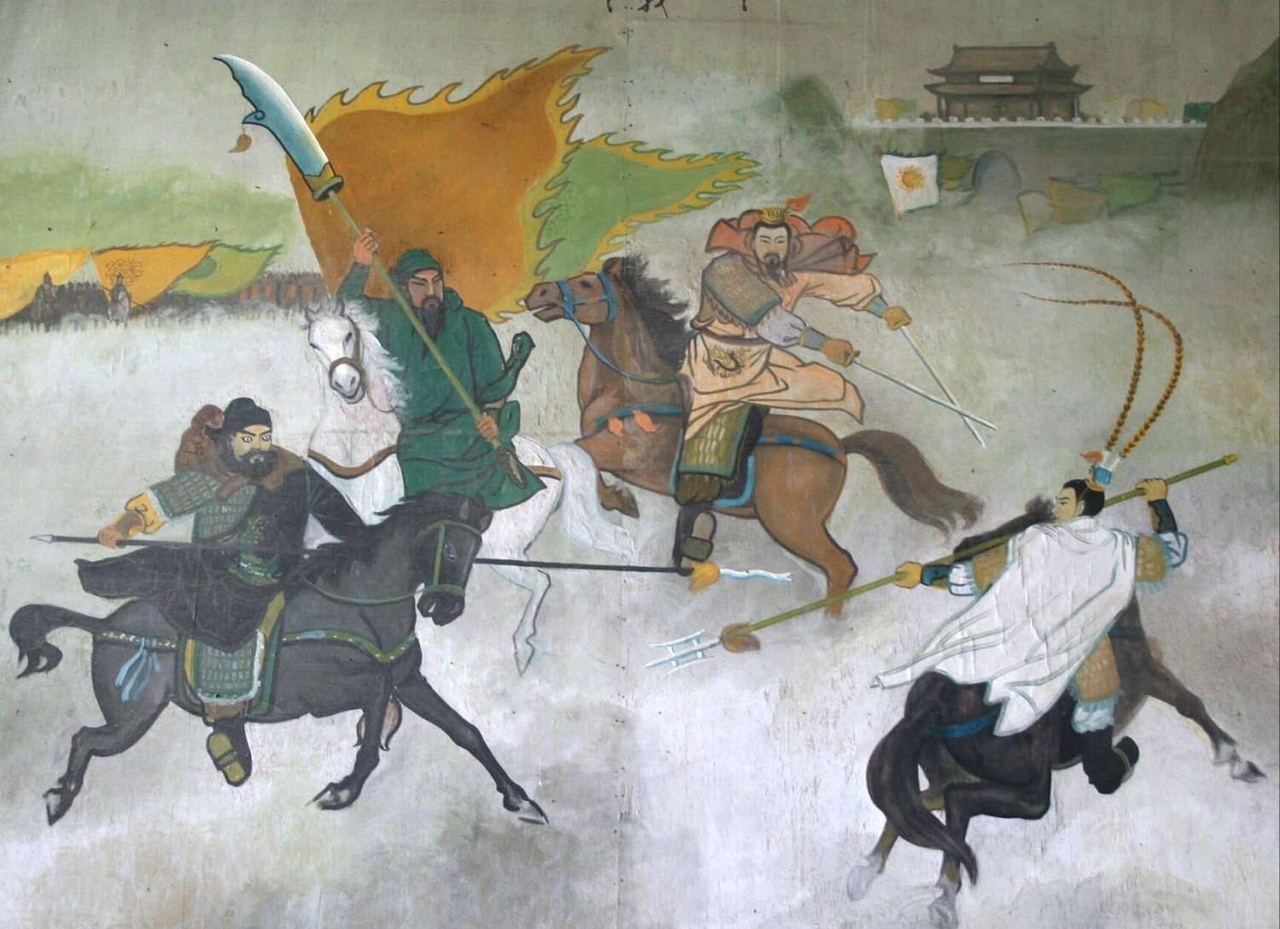
Image: Liu Bei, Guan Yu, and Zhang Fei fighting Lü Bu. Public domain.
When people picture ancient Chinese battlefields, they often imagine towering generals hurling enormous weapons with effortless strength.
Guan Yu’s Green Dragon Crescent Blade, Lü Bu’s Fangtian Huaji, and Zhang Fei’s Serpent Spear have become iconic symbols of near-mythical power.
According to the Romance of the Three Kingdoms, Guan Yu’s blade weighed 82 jin—more than 40 kilograms. Lü Bu’s halberd is listed at 40 jin, Dian Wei’s twin halberds at 80 jin, and in the later Sui–Tang Romance, Li Yuanba’s golden hammers expand to a fantastical 800 jin (about 480 kilograms).
These weights exceed human capability by a wide margin.
Yet, as such stories circulated through folk performances and oral tradition, their protagonists evolved into figures of heroic exaggeration. Guan Yu, in particular, was eventually deified as “Lord Guan,” and his blade became a sacral emblem of loyalty and righteousness. Alongside his famed steed Red Hare, the weapon itself came to be venerated.

Image: Folk performance in front of a Guandi Temple. Zhexian Zhu, CC BY-SA 4.0.
However, the idea that ancient warriors truly fought with weapons weighing dozens—or even hundreds—of jin is a significant misunderstanding.
To correct it, we must examine how Guan Yu’s supposed blade emerged in the historical record and how later generations transformed him into a mythic figure.
2. What Weapon Did Guan Yu Actually Use?
In the Romance of the Three Kingdoms, Guan Yu is portrayed as cutting through enemy generals with his mighty crescent blade.
But when we turn to Chen Shou’s Records of the Three Kingdoms (Sanguozhi), the earliest historical account, a very different image appears: the text never mentions Guan Yu wielding a blade at all.
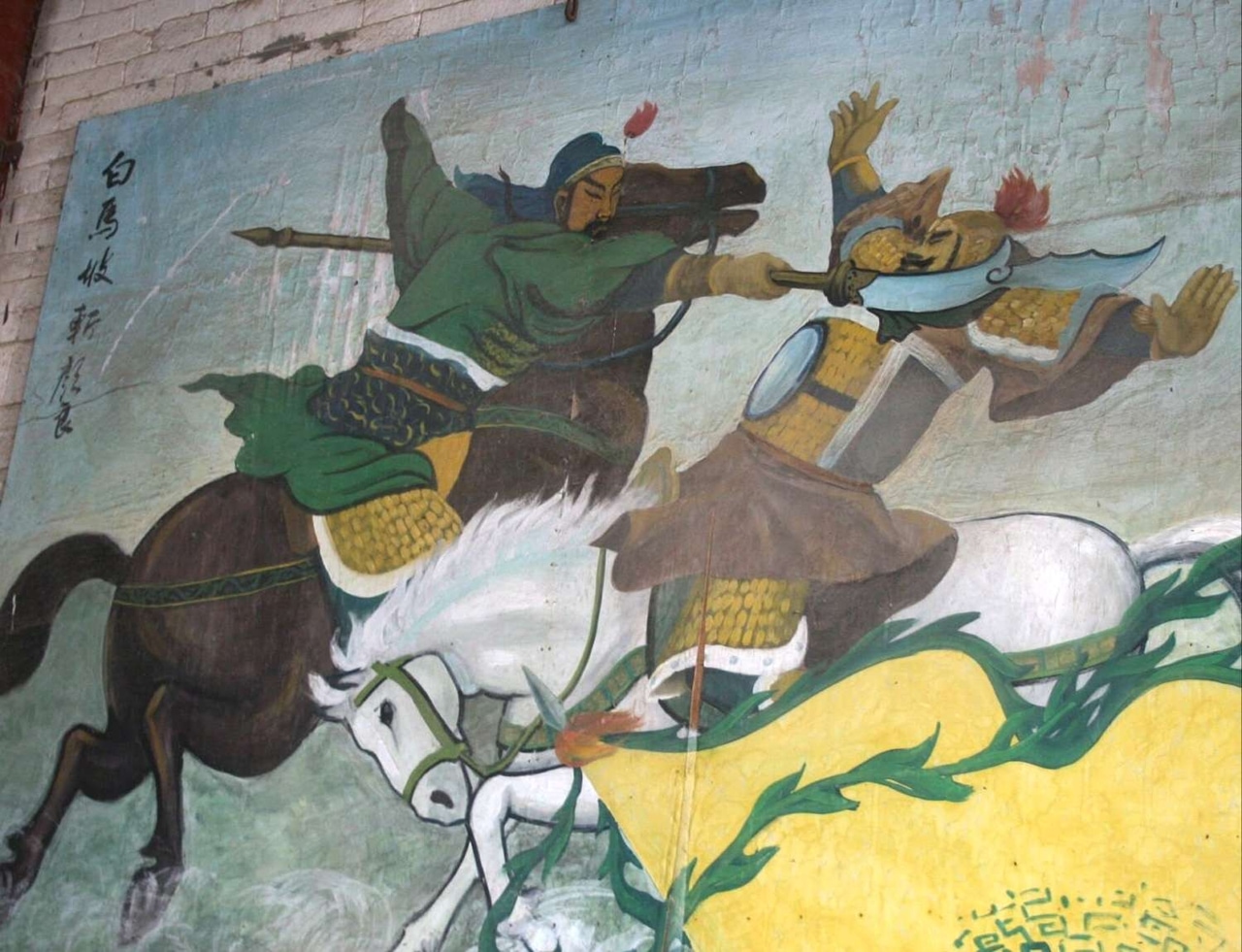
Image: Guan Yu slaying Yan Liang at the Battle of Baimen. Public domain.
In the passage describing his defeat of the general Yan Liang, the verb used is 刺, meaning “to thrust.”
This strongly implies that Guan Yu used a spear or halberd—a thrusting weapon, not a blade.
During the late Eastern Han, long-shafted weapons dominated military combat. Blades were typically secondary, used for rituals or close-range fighting. A massive poleblade like the later yanyuedao did not yet exist.
So where did the association originate?
The earliest known text linking Guan Yu to a blade is Record of Ancient and Modern Swords (Gujin Daojian Lu), written in the early 6th century—around three centuries after Guan Yu lived.
The book, the oldest comprehensive catalogue of Chinese swords, includes the following passage:
> Guan Yu, greatly valued by Liu Bei, mined iron from Mount Wudu and forged two blades named Ten Thousand Men. When he was defeated, he cast them into the water rather than abandon them.
This is widely regarded as a codification of legend rather than historical fact.
Still, it marks the first time Guan Yu appears in literature as a wielder of blades and is generally viewed as the prototype of the later Green Dragon Crescent Blade tradition.
The actual yanyuedao—a heavy, curved polearm—emerged only in the Song dynasty. Impressive in form but unwieldy in practice, it was used mainly for training rather than battlefield combat.
Its existence allowed artists and storytellers to give visual shape to Guan Yu’s legendary weapon, which soon became a staple of paintings and operas.
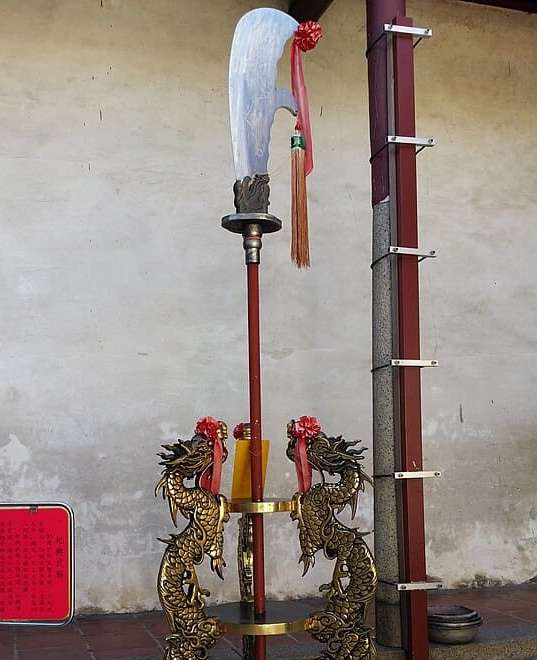
Image: The Green Dragon Crescent Blade symbol of Lord Guan at Wumiao Temple, Tainan, Taiwan. Candyji, CC BY-SA 4.0.
The name “Green Dragon Crescent Blade” itself first appears in the Ming dynasty novel *Romance of the Three Kingdoms.
In the novel’s rich storytelling, the blade is forged under a full moon, and 1,780 drops of celestial blood—said to be the blood of the Azure Dragon—fall upon it, cementing its divine status.
Thus, the historical Guan Yu—almost certainly a spear-wielding general—was gradually transformed into a deified warrior figure forever linked with a legendary sacred blade.
3. Legendary Warriors Versus Real-World Weapons
If taken literally, the weapons described in heroic literature would be impossible for any human—or horse—to wield.
Archaeological evidence paints a much more realistic picture.
Below are several comparisons between legendary descriptions and actual excavated weapons:
Lü Bu’s Fangtian Huaji (Halberd)
Image: Lü Bu charging forward on Red Hare. Public domain.
The novel assigns Lü Bu’s halberd a weight of 40 jin (about 24 kg).
But halberds from the Warring States to Han periods typically feature:
blade length: 40–60 cm
total length: 2–3 meters
weight: **3–5 kilograms
Such a weapon aligns perfectly with Lü Bu’s reputation for mobility and devastating speed on horseback.
Zhang Fei’s Serpent Spear
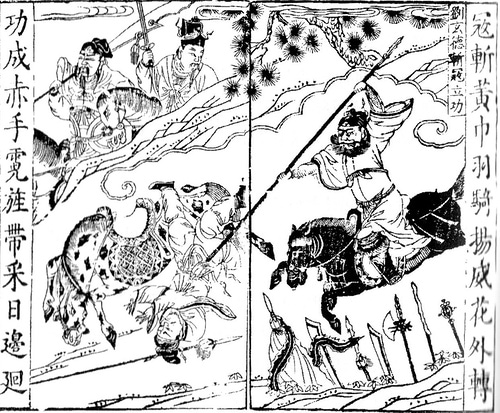
Image: Liu Bei, Guan Yu, and Zhang Fei during the Yellow Turban Rebellion. Public domain.
Zhang Fei’s celebrated Serpent Spear is described as weighing 50 jin (30 kg) in the novel.
Yet excavated spears from the same era weigh only 3–6 kilograms.
This makes the famous scene at Changban Bridge—where Zhang Fei’s bellow supposedly halted thousands of soldiers—far more plausible when imagined with a practical, lightweight spear rather than a 30-kilogram weapon.
Dian Wei’s Twin Halberds and the Tradition of “Superhuman” Strength
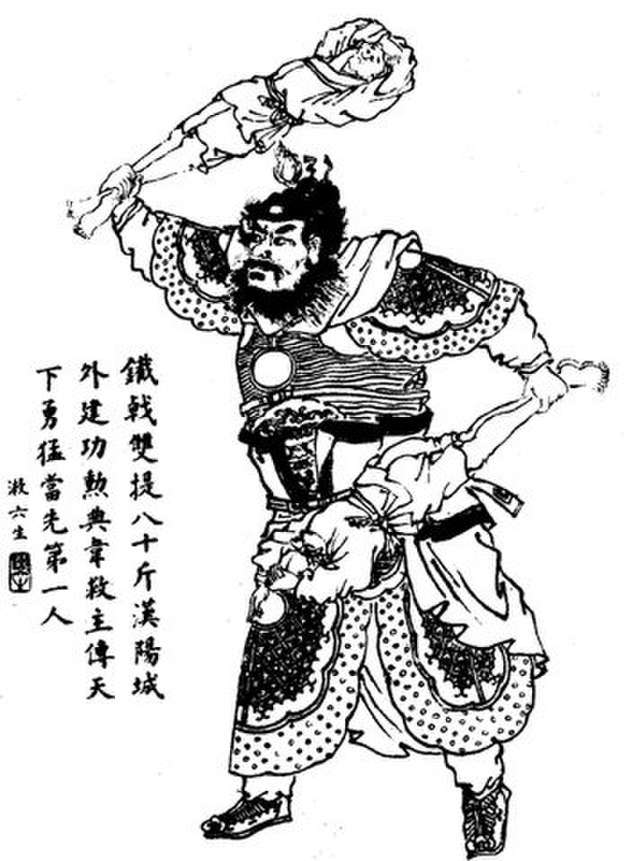
Image: Dian Wei. Public domain.
Dian Wei’s twin halberds are listed at 80 jin (48 kg) in the novel.
But historical examples from the Ming period weigh only 3–4 kilograms each.
More extreme cases, such as Li Yuanba’s 800-jin sledgehammers from Sui–Tang Romance, are entirely fictional. Historical iron clubs (golden-melon maces) generally weigh about 1 kilogram.
Likewise, Lu Zhishen’s 62-jin monk’s staff from Water Margin contradicts excavated monk’s staffs weighing merely 2–3 kilograms.
Most such tales were literary exaggerations meant to elevate warriors’ heroic aura rather than reflect genuine military equipment.
4. Ancient Chinese Weapons Were Engineered for Efficiency
Archaeological measurements and surviving military documents show that ancient Chinese weapons were designed for practicality, endurance, and mobility—not brute strength.
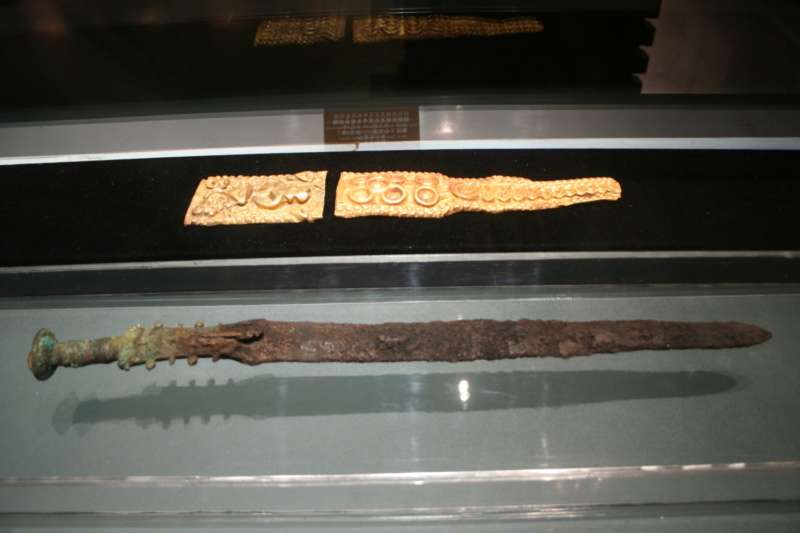
Image: Iron sword from the Western Han period, Kunming City Museum. Public domain.
Excavated examples include:
Western Han iron sword: 66.2 cm, 620 g
Northern Zhou ring-pommel saber: 94.5 cm, 1.3 kg
Qing dynasty *Huangchao Liyi Tushi*: paired maces listed at 1 jin 3 liang each (about 0.65 kg)
Such data reveal that real battlefield needs—long marches, fast maneuvers, prolonged fighting—shaped weapon design.
From infantry to elite generals, soldiers required arms they could wield for hours without exhausting themselves.
In contrast to the exaggerated arms of heroic fiction, actual battlefield weapons were refined and efficient, maximizing combat effectiveness rather than showcasing sheer weight.
Where legend celebrates impossible feats of strength, **history reveals a world where agility, stamina, and practical engineering determined victory.**
Sources Referenced
『Kokin Tōkenroku』 by Tao Hongjing
『Records of the Three Kingdoms』 by Chen Shou
『Romance of the Three Kingdoms, Romance of the Sui and Tang Dynasties, and other traditional narratives』